
Spanish Vocabulary · Common Mistakes · False Friends
10 False Friends in Spanish: Words That Look Like English But Aren't
These Spanish words look familiar — but they mean something completely different. Learn them before they embarrass you in a real conversation.
False friends in Spanish are words that look or sound like English words — but mean something completely different. And they cause some of the most embarrassing mistakes in real conversation.
You see a Spanish word, it looks familiar, you assume you know what it means — and you’re wrong. Sometimes hilariously wrong. Embarazada doesn’t mean embarrassed. Sensible doesn’t mean sensible. Exitoso doesn’t mean “exit-related.” These false friends in Spanish trap even advanced learners because the resemblance to English is so convincing.
In this article, we’ll cover 10 of the most common and most dangerous false friends — with the exact mistake English speakers make, the correct meaning, real sentence examples, and how to use each word correctly from now on.
💡 Important Note for English Speakers
False friends exist because Spanish and English share thousands of words through Latin roots — but those words evolved differently over centuries. The similarity is real, which is what makes these words so tricky. However, once you learn the correct meaning of each one, the confusion disappears permanently. These aren’t random — they follow recognizable patterns once you know what to look for.
🟢 Have you made any of these mistakes? 🟢
Most English speakers have — without knowing it.
In our trial class, we practice real vocabulary in real situations — including the mistakes that are easy to make and hard to notice. Book a free class and clean up your Spanish.
No judgment · No pressure · Just Spanish
10 False Friends in Spanish You Need to Know
1
Looks like "embarrassed" — means something very different
What you think it means
Embarazada
Pregnant
This is the most famous false friend in Spanish — and the most dangerous. If you want to say you’re embarrassed, embarazada is absolutely not the word. In fact, telling someone “estoy muy embarazada” when you meant to say you’re embarrassed will get a very unexpected reaction.
✕ The Mistake
✓ The Correct Version
💬 How to use embarazada correctly
Mi hermana está embarazada — va a tener su bebé en marzo. (My sister is pregnant — she’s having her baby in March.)
2
Looks like "exit" — means something completely different
What you think it means
Éxito
Success
Éxito means success — not exit. The word for exit in Spanish is salida. Therefore, if you see a sign that says “Éxito” in a store (which is also a supermarket chain in Colombia), it’s not pointing you to the door — it’s a brand name meaning “success.”
✕ The Mistake
✓ The Correct Version
💬 How to use éxito correctly
El evento fue un gran éxito — vinieron más de cien personas. (The event was a great success — more than a hundred people came.)
3
Looks like "sensible" — means the opposite of what you'd expect
What you think it means
Sensible
Sensitive
In English, “sensible” means reasonable or practical. In Spanish, sensible means sensitive — emotionally or physically. If you call someone sensible in Spanish thinking you’re complimenting their good judgment, you’re actually saying they’re emotional or easily hurt.
✕ The Mistake
✓ The Correct Version
💬 How to use sensible correctly
Tiene la piel muy sensible — no puede usar ese jabón. (She has very sensitive skin — she can’t use that soap.)
🟢Are you making these mistakes in real conversation?🟢
One class is all it takes to fix them for good.
We practice vocabulary like this in real situations — so the correct word comes out automatically, without having to stop and think. Book your free trial class.
No commitment · Just a real conversation in Spanish
4
Looks like "library" — but you won't find books there
What you think it means
Librería
Bookstore
If you ask someone where the librería is, they’ll point you to a bookstore — not a library. The Spanish word for library is biblioteca. This is one of the false friends in Spanish that catches travelers off guard constantly — especially when they’re looking for a place to sit and read for free.
✕ The Mistake
¿Dónde está la librería? (meaning: where is the library?)
✓ The Correct Version
💬 How to use "librería" correctly
Hay una librería muy buena en el centro — tienen libros en inglés también. (There’s a great bookstore downtown — they have books in English too.)
5
Looks like "actually" — but timing is everything
What you think it means
Actualmente
Currently / Nowadays
Actualmente refers to the present moment — “currently” or “nowadays.” It does not mean “actually” in the sense of “in fact” or “to be honest.” This false friend causes constant confusion in written Spanish especially — and the correct word for “actually” is en realidad or de hecho.
✕ The Mistake
Actualmente, no me gusta. (meaning: actually, I don’t like it)
✓ The Correct Version
💬 How to use actualmente correctly
Actualmente vivo en Miami, pero antes viví en Bogotá. (Currently I live in Miami, but I used to live in Bogotá.)
6
Looks like "carpet" — but it's on the wall, not the floor
What you think it means
Carpeta
Folder / Binder
Carpeta is a folder or binder — the kind you put documents in. The word for carpet or rug in Spanish is alfombra. However, this false friend is especially common in office settings, where asking for “la carpeta” instead of “la alfombra” creates very different results.
✕ The Mistake
La carpeta está sucia. (meaning: the carpet is dirty)
✓ The Correct Version
💬 How to use carpeta correctly
¿Me pasas la carpeta azul? Ahí están todos los documentos del proyecto. (Can you hand me the blue folder? All the project documents are in there.)
MORE MISTAKES TO AVOID
7
Looks like "college" — but it's much younger students
What you think it means
Colegio
School
In Spanish, colegio refers to a primary or secondary school — not a university. The word for university or college is universidad. Therefore, saying you went to colegio for four years means you went to high school for four years — not that you have a college degree.
✕ The Mistake
Fui al colegio en Nueva York. (meaning: I went to college in New York)
✓ The Correct Version
💬 How to use colegio correctly
Mis hijos van al colegio aquí en el barrio — es muy bueno. (My kids go to school here in the neighborhood — it’s very good.)
8
Looks like "introduce" — but not the way you think
What you think it means
Introducir
To insert / To introduce (a concept)
Introducir means to insert something or introduce a concept — not to introduce a person. If you want to introduce someone to another person, the correct verb is presentar. Using introducir to introduce a person sounds very unnatural and sometimes even strange in context.
✕ The Mistake
Te quiero introducir a mi amigo Carlos.
✓ The Correct Version
💬 How to use introducir correctly
Hay que introducir la tarjeta en la ranura para abrir la puerta. (You need to insert the card in the slot to open the door.)
9
Looks like "assist" — but you're not helping anyone
What you think it means
Asistir
To attend
In Spanish, asistir means to attend — as in to be present at an event. It does not mean to assist or help someone. The word for that is ayudar. However, this false friend causes real confusion in formal contexts where you might say you want to “asistir” when you mean you want to help.
✕ The Mistake
Quiero asistirte. (meaning: I want to assist/help you)
✓ The Correct Version
💬 How to use asistir correctly
¿Vas a asistir a la reunión del viernes? (Are you going to attend the Friday meeting?)
10
Looks like "embarrassment" — but this one's about the stomach
What you think it means
Constipado
Having a cold
Saving the most surprising for last. In Spanish, constipado means having a cold or a blocked nose — not the digestive condition the English word refers to. The Spanish word for constipated is estreñido. Mixing these two up in a conversation with a native speaker is guaranteed to cause confusion — and probably laughter.
✕ The Mistake
Estoy constipado. (meaning: I am constipated)
✓ The Correct Version
💬 How to use constipado correctly
Estoy constipado desde el lunes — me duele la cabeza y no puedo respirar bien. (I’ve had a cold since Monday — my head hurts and I can’t breathe well.)
False friends in Spanish don't trick you because you don't know enough. They trick you because you think you do. That awareness alone is most of the fix.
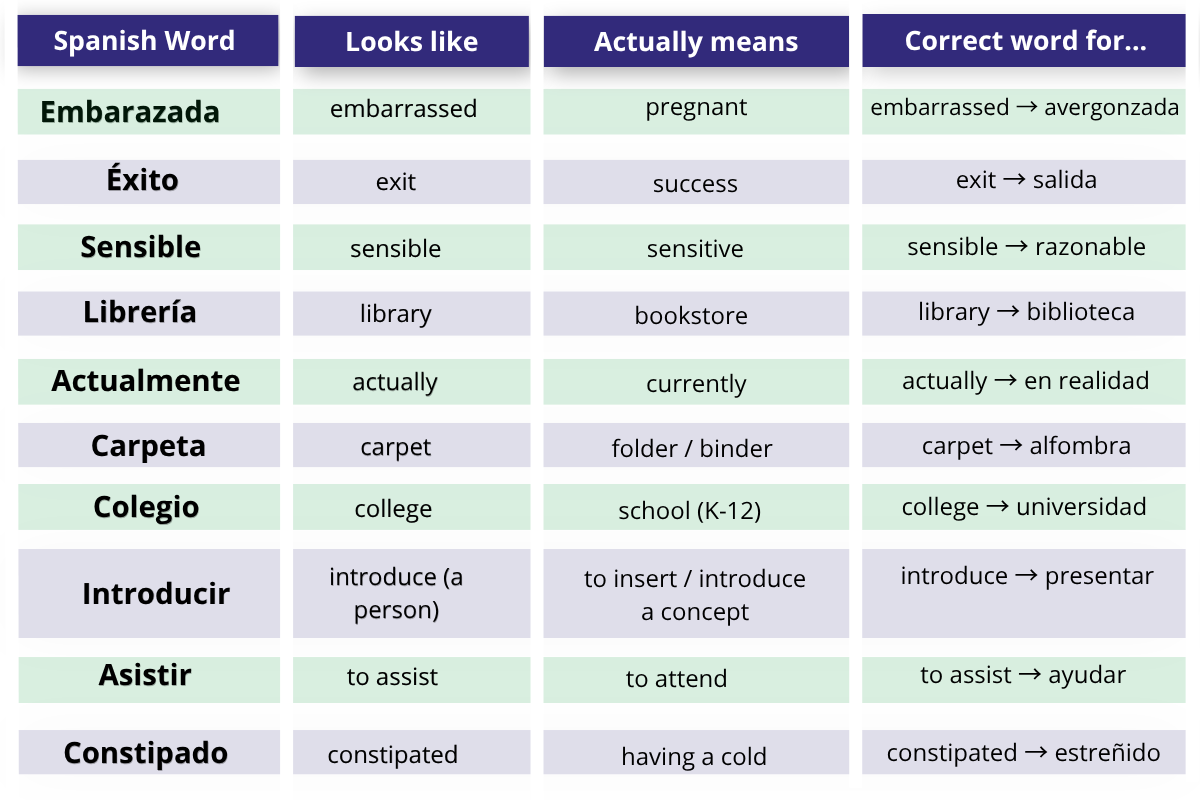
Quick Reference — All 10 False Friends at a Glance
Save this table for your next Spanish conversation. These are the false friends in Spanish that English speakers encounter most — and get wrong most often.
Why False Friends in Spanish Are So Hard to Shake
Here’s the uncomfortable truth about false friends: knowing they’re wrong doesn’t always stop you from using them. Your brain has a strong pattern-matching instinct — it sees a familiar word and fills in the meaning automatically, before you have time to second-guess it.
Therefore, the only reliable fix is repetition in real context. Seeing embarazada in a sentence about pregnancy enough times that the correct meaning loads automatically. Hearing éxito celebrated after an event often enough that “success” comes to mind before “exit” ever does.
That’s why passive reading of vocabulary lists helps less than active use in real conversation — where the stakes are real and the corrections are immediate.
WHY YOUR BRAIN MAKES THESE MISTAKES
✓ What to do right now
Pick three false friends from this list — the ones that surprised you most — and write one sentence with each one used correctly. Say them out loud. Then use them in your next Spanish conversation. The moment you use a word correctly in a real situation, it stops being a false friend and becomes a real one.
🟢No more false friends. Just real Spanish.🟢
Clean up your vocabulary in real conversation — starting today.
Book a free 30-minute trial class with Spanish Chévere. We’ll practice real vocabulary in real situations — including the words that trip up English speakers most — until the right word comes out automatically.
Free trial · No credit card · No obligation
The Bottom Line
False friends in Spanish are one of the most common — and most avoidable — sources of mistakes for English speakers. They don’t happen because you don’t know Spanish well enough. They happen because Spanish and English share a common heritage that makes the words look familiar when they aren’t.
The good news is that these 10 false friends cover most of the situations you’ll encounter. Learn them, use them correctly a few times in real conversation, and they’ll stop being traps — and start being words you know better than most learners do.
Because now you know that embarazada doesn’t mean embarrassed, éxito doesn’t mean exit, and constipado most definitely doesn’t mean what you thought it did.
Share this with someone who’s learning Spanish — they’ll thank you for it.