
Real Spanish · Useful Questions
10 Most Useful Spanish Questions for Any Situation
These 10 essential Spanish questions can help you handle everyday situations when traveling or communicating in Spanish — from restaurants and hotels to stores and getting around a new city. Real examples. Real context. Real Spanish.
These 10 useful Spanish questions are not grammar exercises. They’re survival tools — the exact phrases that get you through real situations when your Spanish isn’t perfect yet.
We’ve all been there. You’re in a restaurant, a store, or a street in a Spanish-speaking country, and something comes up that you don’t know how to handle. Your Spanish freezes. You smile awkwardly and hope the situation resolves itself.
That smile — what we call the “survival smile” — is something every Spanish learner knows. However, learning a few practical questions can make a big difference. These expressions will help you handle many everyday situations, even when your Spanish isn’t perfect yet. Learn them, practice them, and start using them in real conversations. Learn them, practice them, and use them starting today.
This article is based on our Spanish Chévere podcast episode on the same topic. If you prefer to listen and practice with us directly, you can find the episode below.
Spanish Chévere Podcast · Beginners
🟢Want to practice these questions for real?🟢
Knowing questions is one thing. Using them naturally is another.
In our trial class, we practice exactly these situations — until the questions come out automatically in real conversation. No scripts, no drills. Real Spanish.
No judgment · No pressure · Just Spanish
The 10 Most Useful Spanish Questions — With Real Examples
These aren’t random phrases from a textbook. They’re the questions that native speakers use every day — and the ones that learners need most when real situations come up. Therefore, we organized them not just by number, but by when and why you’d use each one.
1
¿Cómo se dice...?
This is the most powerful question a Spanish learner can have. When you don’t know a word in Spanish, you don’t freeze — you ask. And the beautiful thing is that every time you ask, you get a free vocabulary lesson in real context.
Many Spanish speakers are happy to help when you ask what a word means or how to say something. It’s also a natural way to keep the conversation going while learning new vocabulary in context.
✔ ¿Cómo se dice "backpack" en español?
✔ ¿Cómo se dice esto en español?
💡 Pro tip
Use this constantly — it turns every conversation into a free Spanish lesson. The more you ask, the faster your vocabulary grows in real context.
✓ Any situation
✓ Vocabulary building
✓ All levels
Want to sound more natural in Spanish?
Learn 7 everyday expressions that native Spanish speakers actually use in conversations.
Read more: 7 Spanish Phrases Native Speakers Use Every Day →
2
¿Qué significa...?
This one is different from #1 — and the difference matters. ¿Cómo se dice? is when you know the word in English and want it in Spanish. ¿Qué significa? is when you hear a Spanish word you don’t understand and need to know what it means.
In fact, these two questions work as a pair. Together, they cover both directions of vocabulary learning — from English to Spanish, and from Spanish to meaning.
✔¿Qué significa "chévere"?
✔¿Qué significa esa palabra?
💡 The key difference
¿Cómo se dice? = English → Spanish. ¿Qué significa? = Spanish → meaning. Learn both. Use both. They’re your two most powerful vocabulary tools.
✓ Listening comprehension
3
¿Puede repetir más despacio, por favor?
This question is especially useful when someone speaks faster than you’re used to or when you miss part of what they say. In everyday conversations, people may speak naturally and connect their words, making it harder for Spanish learners to understand everything.
Many people will understand that you’re learning and may be happy to repeat themselves. Don’t be afraid to ask for clarification. It’s much better than pretending you understood something you didn’t.
✔ Real situation — try this
💡 Never fake it
Never pretend you understood when you didn’t. Ask this question every time you need it. It saves you from a lot of awkward situations — and from agreeing to things you didn’t mean to agree to.
✓ Essential survival
✓ Use freely
Do you understand Spanish but freeze when speaking?
Discover why you sometimes struggle to respond in Spanish conversations and how to become more confident.
Read more: Why You Freeze in Spanish Conversations
4
¿Dónde está...?
The classic orientation question. Simple, indispensable, and one of the first useful Spanish questions anyone should learn. With ¿dónde está? you never get lost — at least not without being able to ask for help.
And if you don’t understand the answer? You already have question #3.
✔ ¿Dónde está el baño?
✔ ¿Dónde está el hotel / el restaurante / la parada de bus?
✓ Travel essential
✓ Daily use
🟢Halfway through — how many do you already know🟢
Reading them isn't the same as using them.
The best way to make these questions automatic is to practice them in real conversations — with someone who corrects you and keeps you in Spanish. That’s exactly what our trial class does.
No commitment · Just a real conversation in Spanish
5
¿Cuánto cuesta?
Essential for any traveler, shopper, or anyone navigating daily life in a Spanish-speaking country. One form for singular items, one for plural — and the difference is tiny but important.
✔ ¿Cuánto cuesta este café?
✔ ¿Cuánto cuestan estos zapatos?
💡 Note the difference
Singular: ¿Cuánto cuesta? / Plural: ¿Cuánto cuestan? — same question, tiny change at the end. Learn both forms and you’re covered for any shopping situation.
✓ Shopping
✓ Markets
6
¿Me puede ayudar, por favor?
This is a useful and polite way to ask for assistance in everyday situations. You can use it when you need help finding something, understanding instructions, or getting around a new place. Adding “por favor” makes your request sound more courteous, especially when speaking to someone you don’t know.
✔ Real situation — try this
💡 Note
With three questions — #6, #4, and #3 if needed — you resolved the entire situation. That’s how these questions work together.
✓ Opens every door
✓ Travel
7
¿Tiene...?
With ¿tiene…? you can ask whether a place has something available. It’s especially useful in hotels, restaurants, stores, and pharmacies. Just add the item or service you’re looking for.
✔ ¿Tiene wifi?
✔ ¿Tiene menú en inglés? / ¿Tiene mesa disponible?
💡 When the answer is no
If they say “no tenemos” (we don’t have it), simply respond “está bien, gracias” — “okay, thank you.” Clean, polite, and natural.
✓ Hotels
✓ Restaurants
8
¿Cómo llego a...?
This is different from ¿dónde está? — and the difference matters. ¿Dónde está? asks for a location. ¿Cómo llego a? asks for directions — how to get from here to there.
✔ ¿Dónde está el aeropuerto?
✔ ¿Cómo llego al aeropuerto?
💡 Two questions, two uses
¿Dónde está? = location. ¿Cómo llego a? = directions. Know when you need each one and you’ll never be truly lost in a Spanish-speaking city.
✓ Navigation
✓ Travel
9
¿Está incluido...?
This question is especially important for travelers. In many Latin American countries, service charges, breakfast, or additional fees are not always included automatically. Asking upfront avoids unpleasant surprises on the bill.
✔ ¿Está incluido el desayuno?
✔ ¿Tiene costo adicional?
✓ Hotels
✓ Restaurants
10
¿Me recomienda algo?
This is a great question to use when you want a local recommendation. You can ask a waiter what dish to try, a shop assistant what product they suggest, or a tour guide what places are worth visiting.
Asking for recommendations can also lead to interesting conversations and help you discover things you might not find in a guidebook.
✔ Real situation — try this
One question. A complete experience — and probably the best meal of the trip.
💡 Why this question is magic
It works in restaurants, markets, stores, tour agencies — anywhere. And it always starts a real conversation that teaches you something about the local culture. Use it everywhere.
✓ Most powerful
✓ Builds connection
With these 10 questions, you can arrive in any Spanish-speaking country and handle yourself. You don't need perfect grammar. You need the right questions.
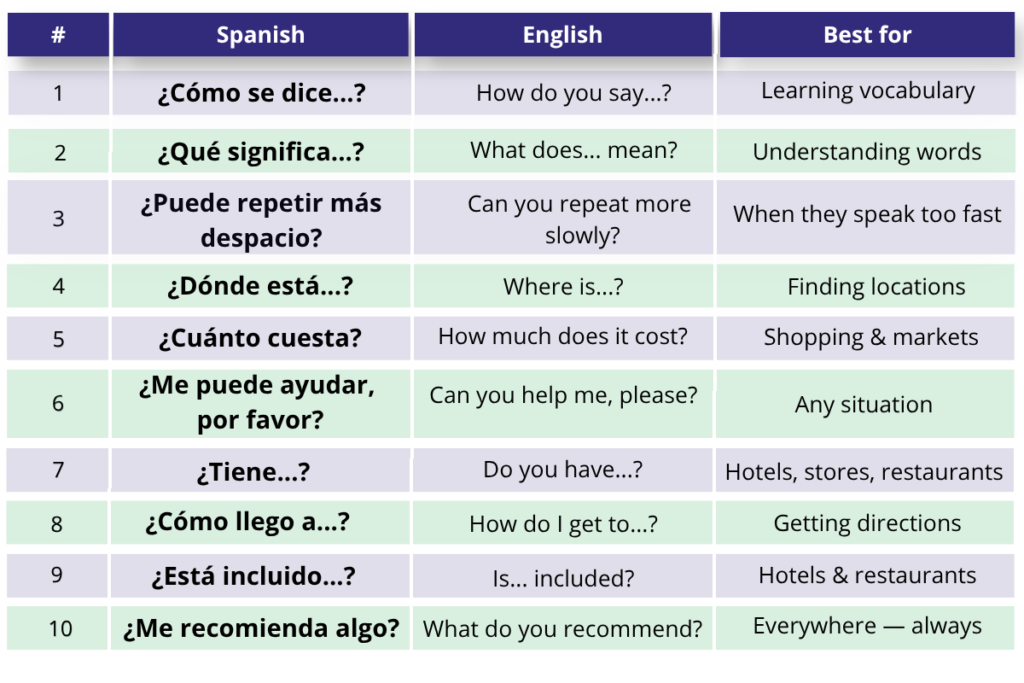
Quick Reference — All 10 Questions at a Glance
Save this table, screenshot it, or write it in a notebook before your next trip. These 10 useful Spanish questions fit in your pocket — and they work in any situation.
⚠️ What Dayari & Ángel recommend
Skipping Week 3. The first two weeks are relatively comfortable — you practice alone, on your own terms, with no real pressure. Week 3 is where the real work happens, and it’s also where most people find excuses to delay. Don’t. The speaking sessions in Week 3 are not optional. They are the entire point of the plan.
SOUND NATURAL IN THOSE CONVERSATIONS
WHY SILENCE BECOMES A HABIT
This article is for you if...
You’re learning Spanish and want practical phrases that work in real situations — not textbook exercises. You’re planning a trip to a Spanish-speaking country and want to feel prepared. Or you already understand Spanish but want to build confidence using it actively. These 10 useful Spanish questions work for all three situations.
🟢Practice makes permanent🟢
Use these questions in a real Spanish conversation — today.
Book a free 30-minute trial class with Spanish Chévere. We’ll practice these questions — and many more — in real conversational situations where you have to use them under actual pressure. That’s what makes them stick.
Free trial · No credit card · No obligation
The Bottom Line
You don’t need perfect Spanish to navigate any situation in a Spanish-speaking country. You need the right questions — and now you have them. These 10 useful Spanish questions cover vocabulary, directions, prices, help, recommendations, and comprehension. Together, they handle almost any situation you’ll encounter.
However, knowing them and using them are different things. The survival smile disappears the moment you use one of these questions for the first time in a real situation — and realize it works. That moment changes everything.
Pick three. Use them this week. The rest follows naturally.