
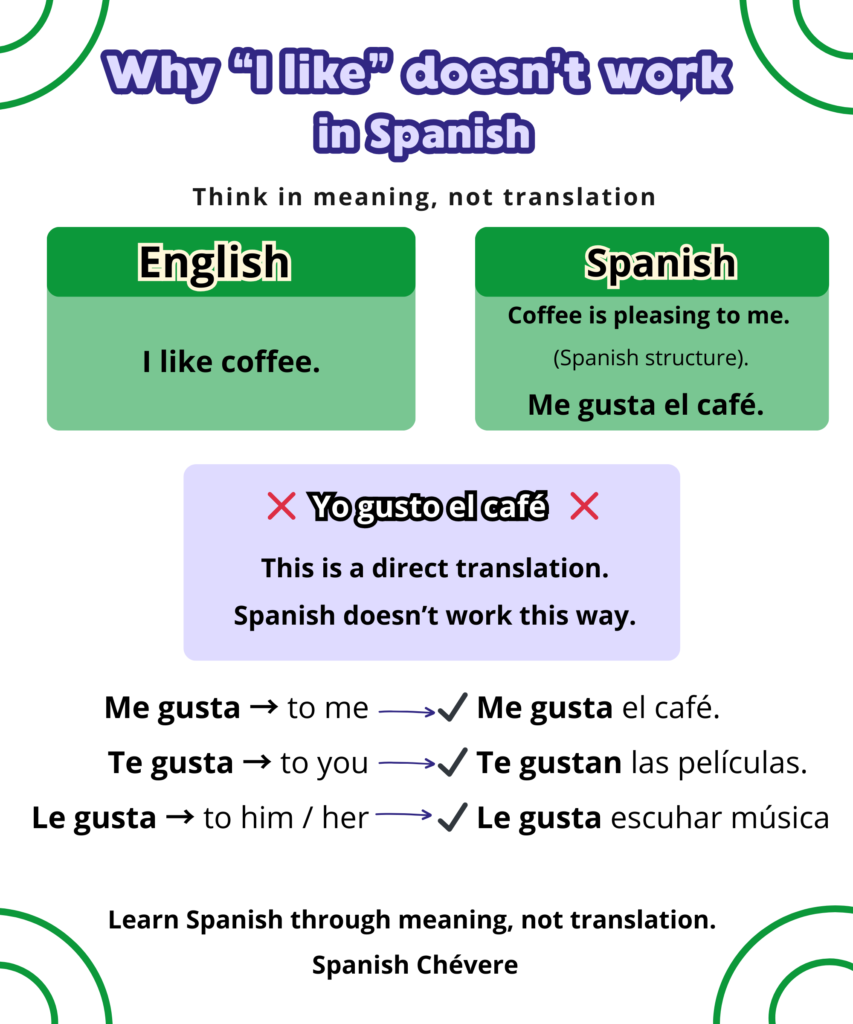
Gustar Explained: Why “I Like” Doesn’t Work in Spanish

Why POR and PARA are so confusing

If you try to translate “I like” directly into Spanish, you will get confused.

English uses a subject-first structure:
“I like coffee.”

Spanish works differently.

That’s why “I like” does NOT translate to “yo gusto”.

💡 Important note for English speakers:

Spanish is not about translating words.
It’s about understanding how meaning is structured.

❌ The most common mistake with “gustar”

Many English speakers try to say:

❌ Yo gusto el café.

This sounds logical in English,
but it is incorrect in Spanish.

🧠 How “gustar” really works

🔵  In English, the person is the subject.        

🟢  In Spanish, the thing is the subject.    

💡 Important Note for English speakers:

In Spanish, you don’t say what you like.
You say what is pleasing to you.

🔵 English:
        I → like → coffee

🟢 Spanish:
       Coffee → is pleasing → to me

GUSTAR: Think in meaning, not translation

Infographic explaining why “I like” doesn’t work in Spanish and how to use gustar correctly

🧩 Why “me”, “te”, “le” appear with gustar

The word “me” does not mean “I”,   It means:  “to me”

  • Me gusta el café.  → Coffee is pleasing to me.
  • Te gusta el café.  → Coffee is pleasing to you.
  • Le gusta el café.  → Coffee is pleasing to him / her.

💡 Important note for English speakers:

These are not subject pronouns.
They show who experiences the feeling.

SINGULAR VS PLURAL

Gustar changes based on the thing you like,  not the person.

  • Me gusta el café. (singular thing)
  • Me gustan las películas. (plural thing)

ONE thing → singular verb

MORE than one thing → plural verb

✔ Me gusta el café.

✔ Me gusta la música.

✔ Me gustan las películas.

✔ Me gustan los libros.

ONE thing → singular verb

MORE than one thing → plural verb

  1. ✔ Me gusta el café.
  2. ✔ Me gusta la música.
  1. ✔ Me gusta el café.
  2. ✔ Me gusta la música.
  1. ✔ Me gustan las películas.
  2. ✔ Me gustan los libros.

💡 Gustar agrees with the thing, not with the person.

⚡ Quick mental shortcut

💡 Don’t think:  “I like…”

💡 Think:  “This is pleasing to me.”

Spanish does not copy English logic. That’s why verbs like:
       ✔ SER vs ESTAR
       ✔ POR vs PARA
       ✔ SABER vs CONOCER
      ✔ and GUSTAR
feel confusing at first.

🚀 Ready to stop translating and start thinking in Spanish?

At Spanish Chévere, we explain grammar through meaning, not memorization.
Practice with real-life examples and English support when you need it.

👉 Book your free Spanish class and start thinking in Spanish, not translating.

Leave a Comment

Your email address will not be published. Required fields are marked *

Scroll to Top