
POR vs PARA in Spanish: Stop Translating “For” and Start Understanding Meaning

Why POR and PARA are so confusing

If you try to translate the word “for” into Spanish, you will get confused.

English uses one word. Spanish uses two: POR and PARA.

But the problem is not memorizing rules.
The problem is how you see the action.

POR looks back at the reason or process.
PARA looks forward to the goal or destination.

💡 No se trata de reglas largas, sino de intención. 💡

The problem with memorizing rules

Many students learn long lists like:

  • POR = reason, cause, exchange…

  • PARA = purpose, destination, deadline…

👉 The result: more confusion, not clarity.

🧠 POR vs PARA: The real difference

🔵  POR = the reason / the process / the cause

        👉  Why something happens or how it happens.

🟢   PARA = the goal / the destination / the result

        👉  Where the action is going.

💡 Important Note for English speakers:

POR looks back.

PARA looks forward.

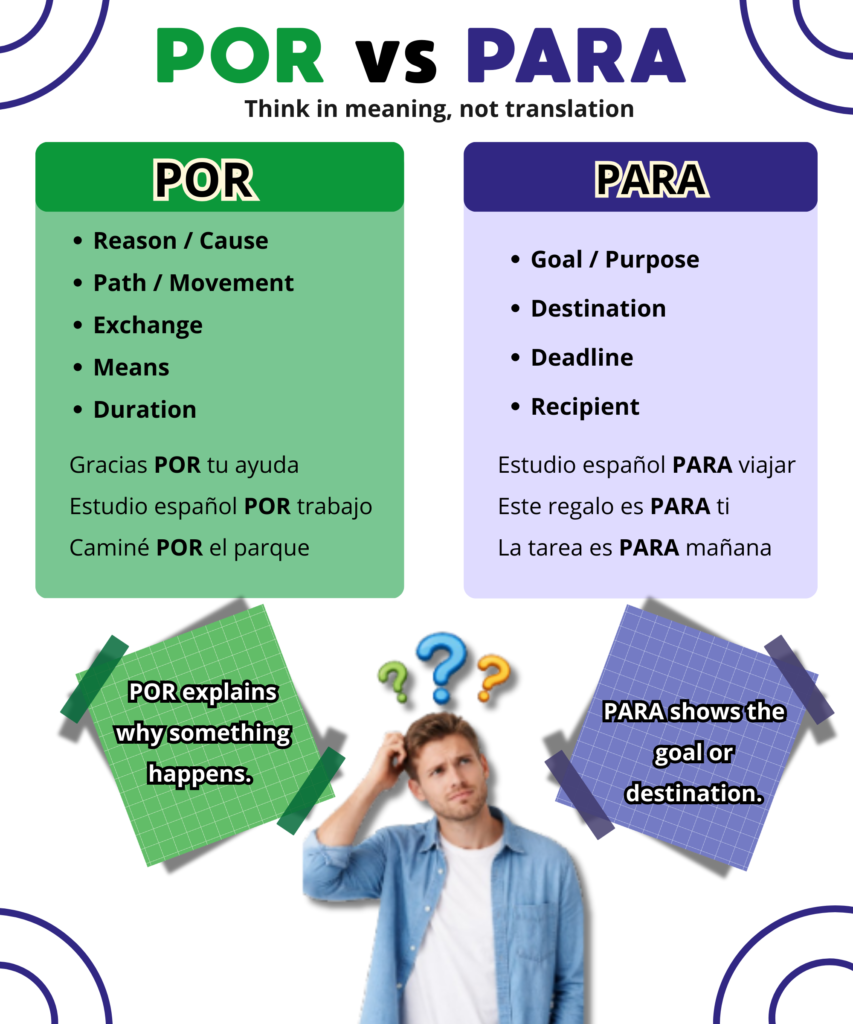
POR vs PARA: Think in meaning, not translation

Spanish grammar infographic explaining por vs para with clear examples for English speakers

When to use POR

Use POR when you explain:

  • the reason

  • the cause

  • the process

Examples:

  • Trabajo por dinero.

  • Gracias por venir.

  • Pagó 10 dólares por el libro.

POR = explica la causa o el medio.

When to use PARA

Use PARA when you talk about:

  • a goal

  • a destination

  • a final result

Examples:

  • Trabajo para aprender español.

  • Este regalo es para mi mamá.

  • Salimos para Madrid.

PARA = indica el objetivo o destino.

Same verb, different meaning

💡 Trabajo por mi familia. → motivation

💡 Trabajo para mi familia. → beneficiary

👉 Small word, big difference.

Quick mental shortcut

✔ POR → looks back (reason / process)
✔ PARA → looks forward (goal / direction)

Stop translating.
Start thinking in meaning.

Another common Spanish verb pair that confuses English speakers is SABER and CONOCER

👉 If you want to understand the difference clearly, read our guide:
Saber vs Conocer Explained for English Speakers.

🚀Ready to stop guessing between POR and PARA?

At Spanish Chévere, we explain grammar through meaning, not memorization.
Practice with real-life examples and English support when you need it.

👉 Book your free Spanish class and finally stop guessing when to use Por  and Para.

Leave a Comment

Your email address will not be published. Required fields are marked *

Scroll to Top