
Ser vs Estar Explained for English Speakers: The DOCTOR vs PLACE Rule (with Clear Examples)
Learning when to use SER and ESTAR is one of the biggest challenges for Spanish learners, especially for English speakers.
❌ Most textbooks say:❌
SER = permanent
ESTAR = temporary
But this explanation often creates more confusion than clarity.
In this guide, you’ll learn a much clearer and more practical strategy used at Spanish Chévere:
👉 The DOCTOR vs PLACE rule, perfect for A1–A2 learners.
💡 Important Note for English speakers:
In English, both ser and estar mean “to be”.
In Spanish, we choose one or the other depending on meaning, not time.
That’s the key difference.
Why “Permanent vs Temporary” Doesn’t Work
This rule fails in many real-life situations:
La clase es aburrida (cuando quieres decir bored)
Mi hermano es enfermo (cuando está sick)
The problem is not time.
The problem is meaning and intention.
Instead of thinking permanent vs temporary, think:
👉 definition vs state
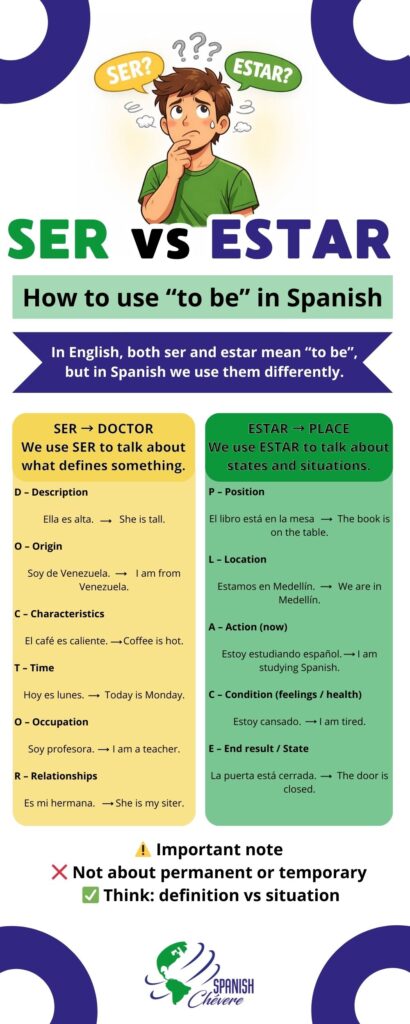
SER → DOCTOR (What defines something)
We use SER to talk about identity, definition, and inherent characteristics.
DOCTOR stands for:
D – Description (descripción)
O – Origin (origen)
C – Characteristic (característica)
T – Time / Date (hora y fecha)
O – Occupation (profesión)
R – Relationship (relación)
Ejemplos:
-
Ella es alta. (She is tall)
-
Él es médico. (He is a doctor)
-
Hoy es lunes. (Today is Monday)
-
Somos amigos. (We are friends)
SER = what something is
SER defines identity
La regla PLACE: cuándo usar ESTAR
We use ESTAR to talk about states, locations, and results.
PLACE stands for:
P – Position (posición)
L – Location (ubicación)
A – Action (acción en progreso)
C – Condition (feelings / health)
E – End result / State (resultado o estado)
Ejemplos:
-
Estoy cansado. (I am tired)
-
Estamos en casa. (We are at home)
-
Ella está estudiando. (She is studying)
-
El café está frío. (The coffee is cold)
👉 ESTAR = how, where or in what condition
SER vs ESTAR: DOCTOR vs PLACE
This visual table helps you choose SER or ESTAR quickly, without relying on the confusing “permanent vs temporary” rule.
Same adjective, different meaning
Some adjectives change meaning depending on the verb:
Ejemplos:
-
Es aburrido → He is boring.
-
Está aburrido → He is bored.
-
Es listo → He is smart.
-
Está listo → He is ready.
💡 Same word, different intention.
Quick recap
✔ SER → DOCTOR → identity & definition
✔ ESTAR → PLACE → state, location, or result
✔ In English both mean to be, but in Spanish they are not interchangeable
Another common Spanish verb pair that confuses English speakers is
SABER vs CONOCER.
👉 If you want to understand the difference clearly, read our guide:
Saber vs Conocer Explained for English Speakers.
Want to stop guessing when to use SER and ESTAR?
At Spanish Chévere, we teach Spanish grammar clearly, practically, and with English support when you need it.
Book your free Spanish class and finally stop guessing when to use SER and ESTAR.
